
COBALT Fellowship
Launched in 2023, the COBALT Fellowship is a one-year, place-based learning journey designed to build the capacity of emerging and established leaders to work at the scale of bioregions. Through interdisciplinary working groups focused on seagrass meadows, coastal systems, and regenerative innovation, Fellows learn how to see, connect, and amplify transformation across ecological, cultural, economic, and technological systems.
Featured Fellow’s Work
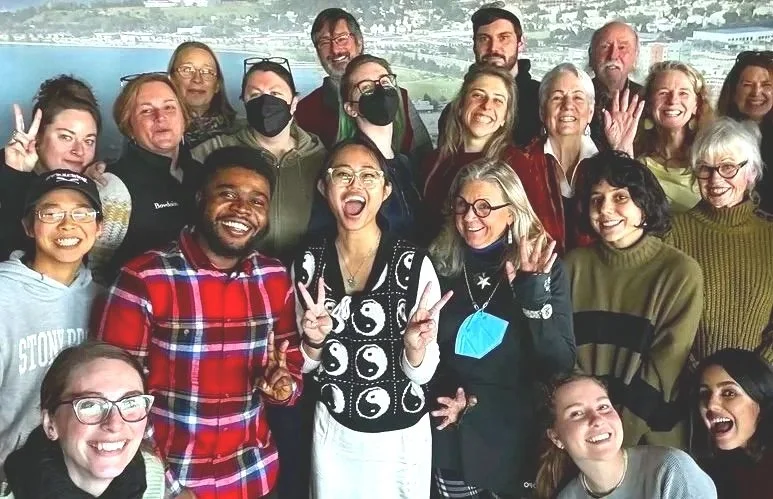
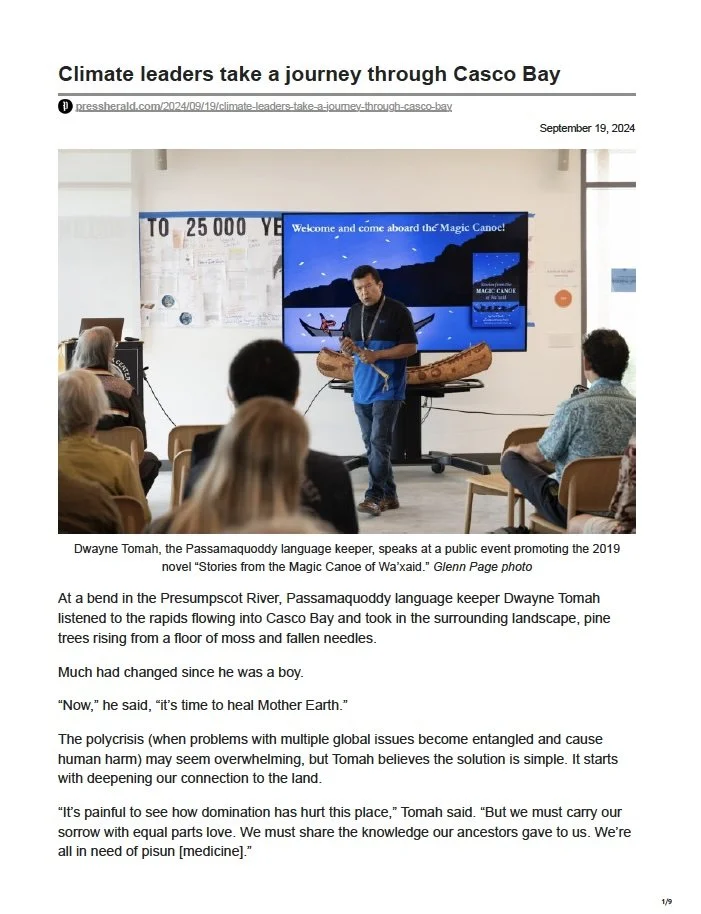
Featured in the Portland Press Herald, the 2024 Bioregional Learning Journey in Casco Bay, Portland Maine was a live experiment in connecting social-ecological systems research with community-based climate action—bringing together diverse ways of knowing to explore pathways for regeneration. Traveling by sea kayak and bicycle, participants engaged in field-based inquiry, dialogue, collaborative mapping, and hands-on eelgrass restoration, linking lived experience of place with systems-level understanding and collective action. Haley co-facilitated and co-designed the journey with Glenn, drawing on her PhD research on methodological pluralism to adapt systemic design approaches from mountain to coastal contexts. This collaboration helped shape COBALT’s evolving methodology and led to her role as Associate Director.
2023-2024 Cohort: Haley Fitzpatrick & Tobias Fechner
2022-2023 Cohort: Sydney Hay & Hailey Rizzo
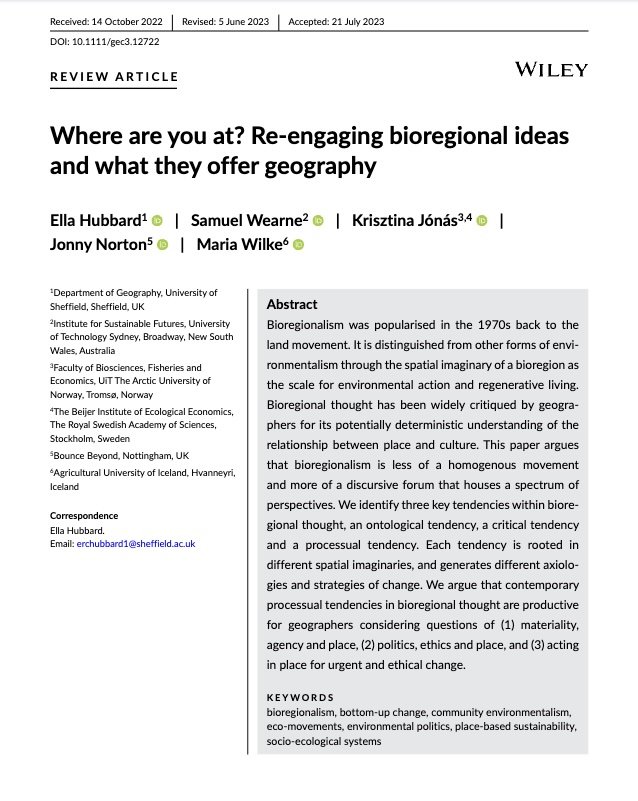
Through the Geography Compass peer-reviewed article “Where are you at? Re-engaging bioregional ideas and what they offer geography,” COBALT fellows collaborated to synthesize interdisciplinary research and re-examine the role of bioregional thinking in addressing environmental and social challenges . Their work reframes bioregionalism not as a fixed concept, but as an evolving, plural set of practices that engage questions of place, power, and ethics. By articulating different tendencies within bioregional thought and highlighting its relevance to materiality, governance, and action in place, the article offers a foundation for more just, place-based approaches and helps bridge theory with real-world pathways for socio-ecological change.
2021-2022 Cohort: Ella Hubbard, Samuel Wearne, Krisztina Jónás, Jonny Norton, and Maria Wilke
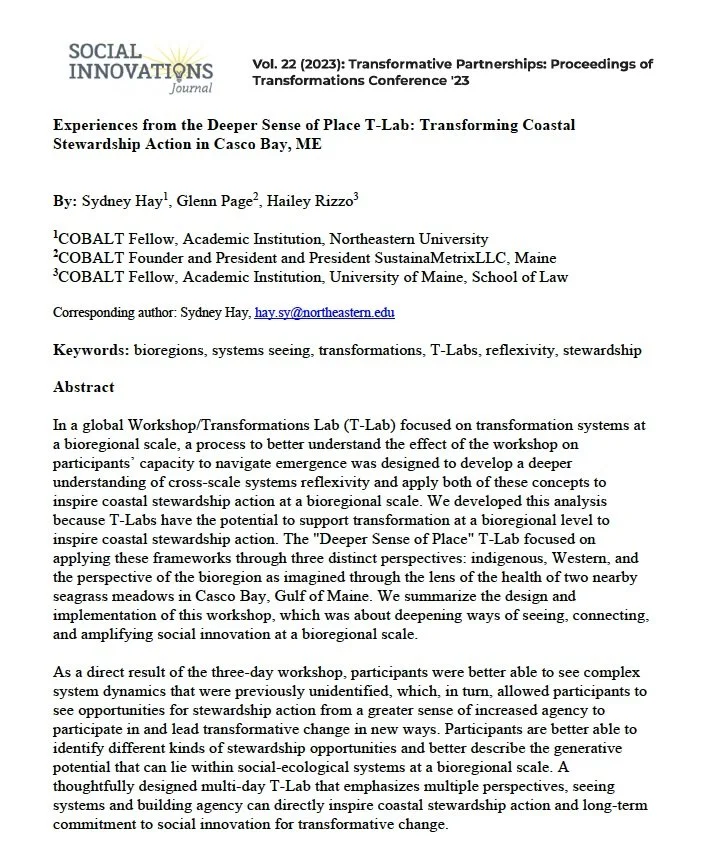
Building on the Deeper Sense of Place T-Lab, fellows Sydney Hay and Hailey Rizzo co-wrote the Social Innovations peer-reviewed article “Experiences from the Deeper Sense of Place T-Lab: Transforming Coastal Stewardship Action in Casco Bay, ME,” translating a multi-day, immersive workshop into insights on how bioregional learning builds systems understanding, agency, and real-world stewardship action. Drawing from facilitation and analysis, their work shows how bringing diverse perspectives together—from Indigenous, scientific, and community lenses—can help participants see complex system dynamics, strengthen collaboration, and identify new pathways for stewardship. The article highlights how this process not only deepens connection to place, but equips participants to take coordinated, place-based action and sustain long-term engagement in regenerative change.
Join the COBALT Fellowship
-
Open to individuals of all ages, geographies, and professional backgrounds. We encourage diverse individuals to apply. We intentionally bring together scientists, artists, technologists, policy thinkers, finance professionals, students, community leaders, and career transitioners who share a commitment to regenerative transformation.
-
Fellows engage in applied, place-based projects connected to our active Working Groups. You may join an existing initiative or bring your own idea forward if it aligns with our bioregional focus.
Projects may include:
Systems mapping of food, coastal, and social-ecological networks
Seagrass science, GIS modeling, and field-based research
Cultural, artistic, and storytelling initiatives for stewardship
Living Atlas and digital twin development
Regenerative finance and community-based conservation strategies
Language preservation and traditional ecological knowledge integration
All work contributes to real-world bioregional regeneration efforts.
-
The Fellowship combines hands-on project work with transdiciplinary guidance and structured learning through COBALT’s courses and workshops.
Over the year, Fellows receive:
Advanced training in systems thinking and bioregional regeneration
Instruction in applied tools such as ArcGIS Storymaps, system mapping, and regenerative design frameworks
Mentorship from experienced practitioners working at the science–policy–practice interface
Peer-to-peer exchange within a culturally diverse, interdisciplinary cohort
Exposure to real-world conservation, design, finance, and governance challenges
Fellows leave with deeper ecological literacy, refined systems leadership skills, practical project experience, expanded professional networks, and the confidence to design and lead regenerative initiatives within their communities.